The digital marketing world faces an unprecedented crisis like semantic cannibalization. Website owners enthusiastically adopt AI writing tools to scale content production. However, they unknowingly trigger a devastating problem: keyword/Semantic cannibalization. This issue multiplies rapidly when artificial intelligence generates your content.
Let’s explore how AI-induced keyword cannibalization destroys your hard-earned search rankings. More importantly, we’ll discover practical solutions to fix keyword cannibalization before it’s too late.
Understanding Keyword Cannibalization
Keyword cannibalization happens when multiple pages on your website compete for the same search terms. Search engines become confused about which page deserves to rank. Consequently, none of your pages achieve their full potential in search results.
Think about it this way: You’re essentially competing against yourself. Your pages fight each other instead of fighting your competitors. This internal battle weakens your entire domain’s performance.
Traditional keyword cannibalisation resulted from poor planning. However, the AI revolution has intensified this problem dramatically. Now websites generate dozens of similar articles within hours, creating massive content cannibalisation issues.
The Rise of AI-Induced Keyword Cannibalization
AI-induced keyword cannibalization represents a new breed of SEO problem. Unlike traditional cannibalization, this issue stems from AI’s predictable content patterns. AI text generator tools create remarkably similar content structures, topics, and even semantic approaches.
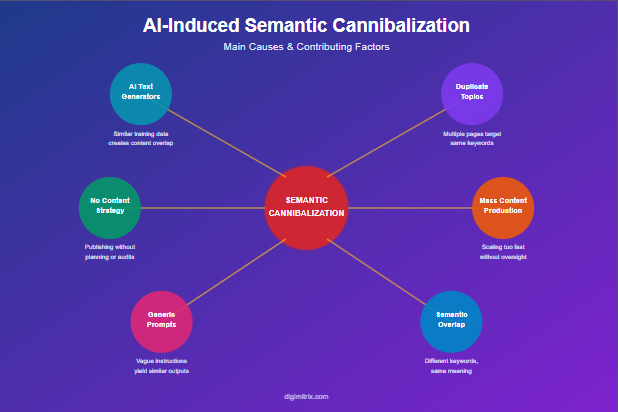
When you use an ai text generator repeatedly, it produces articles that overlap semantically. These tools lack strategic understanding of your existing content ecosystem. Therefore, they can’t prevent creating competing pages.
Moreover, ai writing tools causing cannibalization operate faster than human writers. You can generate 50 articles in a day. However, without proper strategy, those 50 articles might target nearly identical topics. This creates what experts call semantic cannibalization from ai content.
How AI Text Generators Create Content Overlap and Semantic Cannibalization
AI text generator platforms draw from similar training data. Consequently, they often suggest comparable subtopics, examples, and structures. When you create multiple pieces about related subjects, the semantic overlap becomes inevitable.
For instance, prompting an ai text generator about “social media marketing” five times produces five articles covering largely identical ground. Each piece discusses engagement, algorithms, and content strategy. Search engines recognize this redundancy immediately.
Furthermore, ai-generated content cannibalisation happens because these tools optimize for similar keywords naturally. They identify high-value terms and use them repeatedly across different articles. This creates direct competition between your own pages.
The Connection to Topical Authority Collapse
Topical authority represents your website’s expertise within specific subject areas. Search engines reward sites that comprehensively and authoritatively cover topics. However, building topical authority requires strategic content architecture, not random article generation.
AI-induced semantic cannibalization directly causes topic authority collapse due to ai content. When your pages compete internally, search engines receive conflicting expertise signals. They can’t identify your definitive resource on any given topic.
Additionally, semantic authority loss occurs when backlinks scatter across multiple similar pages. Instead of one authoritative page earning 100 backlinks, ten competing pages earn 10 backlinks each. This fragmentation significantly weakens your ranking power.
Low topical authority in seo manifests when competitors with fewer but better-organized pages outrank your extensive content library. This frustrating paradox results from poor content architecture rather than insufficient content volume.
Identifying Keyword/Sematic Cannibalization in Your Content
Identifying keyword cannibalisation requires systematic analysis. Start with a comprehensive keyword cannibalization audit of your website. List every published page alongside its target keywords and main topics.
Next, search Google using “site:yourwebsite.com [target keyword]” operators. If multiple pages appear for the same query, you’ve confirmed cannibalization. This simple test reveals competition between your own URLs.
Additionally, examine your Google Search Console data. Look for keywords where multiple URLs fluctuate in rankings. When several pages trade positions for identical terms, that’s clear evidence of internal competition.
Furthermore, analyze semantic overlap beyond exact keywords. AI chatbot content cannibalization often involves pages targeting different keywords but covering identical concepts. Modern search engines understand these semantic relationships.
Detecting Keyword/Sematic Cannibalization in SEO Tools
Detecting keyword cannibalization in seo becomes easier with proper tools. Many SEO platforms now offer cannibalization detection features. These tools automatically identify pages competing for similar terms.
Use crawling software to map your content structure. Look for clusters of pages with overlapping topics, similar word counts, and comparable keyword densities. Most SEO audit platforms can detect these patterns automatically. These clusters typically indicate ai content keyword cannibalisation problems.
Monitor your rankings weekly. When multiple pages show ranking volatility for related terms, investigate immediately. This pattern suggests internal competition from ai-generated blogs stealing each other’s potential.
The Problem of Semantic Overlap Caused by AI Writing Tools
Semantic overlap caused by ai writing tools extends beyond simple keyword matching. AI content often shares identical information architecture, similar examples, and comparable depth of coverage.
For example, three articles about “email marketing strategies” might use different primary keywords. However, they all discuss subject lines, segmentation, and automation. Search engines recognize this semantic similarity instantly.
Moreover, ai writing tools generate predictable content patterns. They structure information similarly, use comparable transitions, and even select similar supporting details. This homogeneity makes semantic cannibalization inevitable at scale.
How AI Chatbots and Assistants Contribute
The widespread availability of ai chatbot and ai assistant tools has democratized content creation. Anyone can now generate articles without writing skills. Unfortunately, this accessibility creates massive content cannibalisation seo problems.
Business owners generate content without understanding SEO fundamentals. They produce dozens of articles covering similar ground, believing more content equals better rankings. Instead, they create internal competition that tanks all their pages.
Free ai writer tools particularly contribute to this problem. Users generate unlimited content without strategic planning. They don’t map topics, assign unique angles, or prevent overlap. The result? Loss of topical authority from ai text generators across their entire domain.
AI Content Scaling SEO Problems
AI content scaling seo problems emerge when businesses prioritize quantity over strategy. They use ai text generator tools to publish 10, 20, or 50 articles monthly. However, without proper planning, this volume creates more problems than solutions.
The issue compounds in competitive niches. Multiple websites use similar AI tools to generate content about identical topics. This creates an internet flooded with semantically similar articles, all competing for the same rankings.
Furthermore, search engines have become sophisticated at detecting AI-generated patterns. When your site publishes numerous similar AI-written pieces, algorithms may devalue your entire content library. This triggers catastrophic ranking losses.
Resolving AI Content Cannibalization
Resolving ai content cannibalization requires immediate action. First, pause all AI content generation until you complete a thorough audit. Continuing to publish without strategy only worsens the problem.
Next, conduct a keyword cannibalization audit. Identify every instance where multiple pages target similar terms or topics. Group these pages into clusters based on semantic similarity.
For each cluster, designate one page as your primary authority. This should be your most comprehensive, well-optimized piece. Then decide what to do with competing pages: redirect them, rewrite them with unique angles, or delete them entirely.
How to Fix Content Sematic Cannibalisation Permanently
Learning how to fix content cannibalisation requires understanding root causes. You must change your content creation process fundamentally, not just address existing problems.
Start by creating a comprehensive content map before generating any new articles. Identify your main topic pillars and supporting subtopics. Assign specific, unique angles to each planned piece.
When using an ai text generator, provide highly specific prompts. Don’t just ask for “an article about social media marketing.” Instead, specify: “Create an article about Instagram Reels algorithm strategies for e-commerce brands targeting Gen Z audiences.”
Additionally, implement mandatory review processes. Before publishing any AI-generated content, verify it doesn’t overlap with existing articles. Check topic coverage, keyword targeting, and semantic themes.
Fixing Semantic Cannibalization with Strategic Consolidation
Fix keyword cannibalization/Semantic Cannibalization through strategic content consolidation. When multiple weak articles compete, combine them into one comprehensive resource. This concentrated approach builds stronger topical authority.
Use 301 redirects to point old URLs to your new consolidated page. This preserves any backlinks and ranking signals from the old pages. Search engines then understand that one page now serves as your definitive resource.
Update your internal linking structure accordingly. Replace links to deleted pages with links to your new authority pages. This helps search engines understand your intended content hierarchy.
Building Topical Authority in SEO Correctly
Building topical authority in seo requires methodical planning. Start with topic research to identify all relevant subtopics within your niche. Then create a hierarchical content structure with clear pillar pages and supporting articles.
Each piece must serve a distinct purpose. Your pillar page provides broad topic overview. Supporting articles dive deep into specific aspects that your pillar page mentions briefly. This creates natural internal linking opportunities without competition.
Furthermore, ensure every article adds unique value. Don’t publish content just to meet quotas. Each piece should answer specific questions, target unique keywords, or serve distinct audience segments.
Avoid low topical authority by maintaining consistent expertise signals. Publish regularly within your niche, earn relevant backlinks, and demonstrate comprehensive topic coverage. However, always prioritize strategic quality over random quantity.
The Role of Human Oversight in AI Content to coup Semantic Cannibalization
Artificial intelligence offers powerful assistance for content creation. However, human oversight remains absolutely essential. Humans must guide strategy, prevent overlap, and ensure genuine uniqueness.
Train your team to recognize semantic cannibalization risks. Before approving any ai text generator output, they should verify it occupies a unique content niche. They must confirm it doesn’t compete with existing pages.
Additionally, human editors bring contextual understanding that AI lacks. They recognize subtle topic distinctions that prevent cannibalization. They understand your audience’s needs and can differentiate content accordingly.
Preventing Future AI-Induced Issues due to Semantic Cannibalization
Prevention beats correction every time. Establish strict protocols before using any ai assistant or free ai writer tool. Create detailed content briefs that specify unique angles, target audiences, and specific subtopics.
Maintain a centralized content calendar tracking all published topics and planned angles. This prevents different team members from unknowingly creating competing content using ai writing tools.
Schedule regular content audits quarterly. Review new publications for potential cannibalization issues. Address problems immediately before they damage your rankings significantly.
Measuring Recovery from Topic Authority Collapse
After implementing fixes, monitor your recovery progress carefully. Track rankings for your designated authority pages. You should see steady improvement as search engines recognize your clearer content structure.
Watch organic traffic patterns closely. Initially, you might experience temporary drops from consolidating or removing content. However, your remaining strong pages should gain traffic as internal competition disappears.
Monitor backlink concentration too. New backlinks should increasingly point to your authority pages rather than spreading across duplicate content. This concentration amplifies your topical authority signals.
Finally, track engagement metrics like time on page and bounce rate. When visitors find exactly what they need without confusion, these metrics improve dramatically.
Long-Term Content Strategy to Avoid Semantic Cannibalization
Sustainable content strategy balances AI efficiency with human strategic thinking. Use ai chat tools for research, outlining, and draft creation. However, always apply human judgment for final strategy and publication decisions.
Develop clear guidelines specifying when AI assistance is appropriate. For core pillar content and critical authority pages, consider human-only creation. Reserve AI tools for supporting content that follows your established strategy.
Remember that topical authority builds slowly but collapses quickly. Protect your investment through disciplined content creation. Every piece should strengthen your authority rather than fragment it.
Moving Forward with AI Content Tools to get better results
The future involves AI collaboration, not AI domination. Smart businesses use ai text generator tools as assistants within broader strategies, not as the strategy itself.
They maintain human oversight, strategic planning, and quality control. They create content serving genuine user needs rather than merely filling publication schedules with AI output.
By preventing keyword cannibalization and ai-induced semantic cannibalization, they build sustainable topical authority. Their content ecosystems strengthen over time rather than collapsing under their own weight.
Understanding these principles helps you harness AI’s power while avoiding its pitfalls. You can scale content production without sacrificing SEO performance. The key lies in strategic thinking combined with technological efficiency.
Partner with Digimitrix for Strategic Digital Success
At Digimitrix, we understand the complexities of modern digital marketing in the AI era. Our team combines ai text generator efficiency with strategic human expertise to build strong online presences without the pitfalls of content cannibalisation. We offer comprehensive digital marketing services including SEO strategy, content architecture planning, and topical authority building. Additionally, our web development services create technically sound foundations that support your content strategy. Whether you’re recovering from keyword cannibalization or building authority from scratch, Digimitrix provides the strategic guidance and technical execution you need to succeed in today’s competitive digital landscape.