Healthcare Marketing Strategies That Actually Bring In Patients
Healthcare marketing has changed more in the last five years than in the previous two decades combined. Patients now research symptoms, compare providers, and read reviews long before they book an appointment. At the same time, search engines and AI tools increasingly shape which practices patients even discover in the first place. A peer-reviewed patient behavior study found that nearly 40 percent of patients search the internet for information before their first visit with a new provider, and that share climbs even higher among younger patients.
This shift creates real pressure for hospitals, clinics, and specialty practices. A great provider with an outdated marketing approach often loses patients to a less experienced competitor who simply shows up first online. Fortunately, effective healthcare marketing strategies do not require guesswork. They require the right approach, applied consistently.
This guide walks through the healthcare marketing strategies that move the needle for providers today, from local search visibility to patient trust to conversion-focused website design. Each section builds on the last, so read straight through if you want a complete roadmap, or jump to the section most relevant to your current priority.
Why Healthcare Marketing Requires a Different Playbook
Healthcare marketing differs from most other industries for a simple reason: trust carries far more weight than price or convenience. A patient choosing a cardiologist or a dermatologist rarely picks based on the lowest price. Instead, they look for credibility, clear communication, and evidence that other patients had a good experience.
Additionally, healthcare marketing operates under stricter compliance requirements than most industries. Claims about outcomes, testimonials, and even certain keywords need careful handling to stay compliant with HIPAA and platform-specific advertising policies. Because of this, a generic marketing playbook borrowed from retail or e-commerce rarely works well for a medical practice.
Consequently, the strategies below focus specifically on what builds trust and visibility within these constraints, rather than generic growth tactics.
How Patients Actually Choose a Healthcare Provider Today
Before diving into specific tactics, it helps to understand the actual decision path patients follow, since that path shapes which channels deserve the most attention.
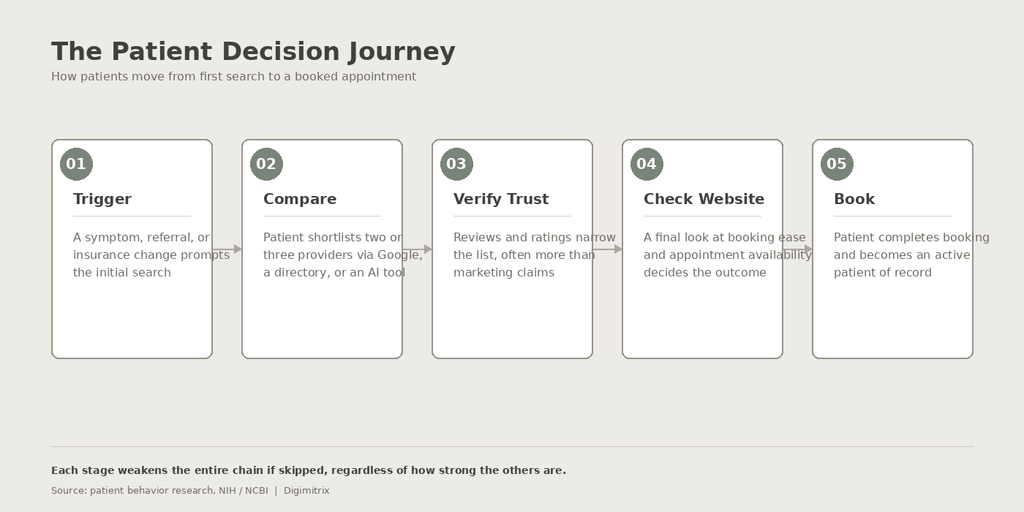
Patient decision-making today typically moves through a few consistent stages:
- A symptom, referral, or insurance change prompts the initial search
- The patient compares two or three providers, usually through Google, a directory site, or an AI search tool
- Reviews and ratings narrow the list further, often more than the provider’s own marketing claims
- A final check of the website, particularly booking ease and appointment availability, determines whether the patient converts
Research on patient review behavior reinforces just how much this reputation stage matters. According to survey data reported by Software Advice, 71 percent of patients use online reviews specifically to evaluate and select a new doctor, which places reputation management on par with clinical credentials in the patient’s actual decision process.
This decision path explains why the strategies in this guide overlap so heavily. Local SEO gets a practice into the initial comparison set. Content and reviews build the trust needed to survive that comparison. A well-designed website closes the loop by removing friction at the final step. Skipping any single stage weakens the entire chain, no matter how strong the other stages are.
Build a Local SEO Foundation That Actually Converts
Most patients search with local intent, whether that means “pediatrician near me” or “urgent care open now.” Because of this, local SEO remains the single highest-return channel for most healthcare practices.
Start with these foundational steps:
- Claim and fully complete your Google Business Profile, including specialties, insurance accepted, and current hours
- Keep your practice name, address, and phone number identical across every directory and listing
- Create separate location pages if your practice serves more than one office or region
- Encourage patients to leave reviews consistently, since both review volume and recency influence local rankings
Beyond the basics, healthcare-specific directories carry real weight as well. Platforms like Healthgrades, Zocdoc, and WebMD’s provider directory combine location data with medical credibility signals that generic directories cannot match. Claiming and optimizing these profiles often produces results that generic local citations alone cannot deliver.
Structured data markup also deserves attention. Adding LocalBusiness and MedicalOrganization schema to your website helps search engines and AI tools understand your specialties, hours, and locations with far greater precision. This technical step takes relatively little development time but strengthens both traditional search rankings and how AI tools summarize your practice.
Review generation deserves its own workflow rather than an occasional reminder to front-desk staff. Practices that build review requests directly into their post-visit process, whether through an automated text message or an email sent within a few hours of the appointment, consistently gather more reviews than practices that ask sporadically. Timing matters here as much as the ask itself, since patients are far more likely to respond while the visit is still fresh in their memory.
It also helps to diversify where those reviews live. Google reviews carry the most weight for local search visibility, but a presence across Healthgrades, Zocdoc, and specialty-specific directories signals credibility to both search engines and patients who cross-reference multiple sources before booking.
Create Content That Answers Real Patient Questions
Patients turn to search engines with specific health questions long before they ever call a practice. Content that directly answers those questions builds trust and captures that early-stage interest.
Effective healthcare content formats include:
- Condition and symptom guides that explain what a patient might expect at each stage
- Treatment comparison posts, such as explaining the difference between two similar procedures
- Provider spotlight posts that highlight credentials, philosophy of care, and areas of focus
- Short educational videos that walk through a common procedure or answer a frequent question
Consequently, this kind of content naturally earns backlinks and social shares, both of which strengthen your broader SEO profile over time. A consistent publishing calendar matters here as well. Practices that publish one or two well-researched articles each month tend to outperform practices that publish in occasional bursts, since search engines favor sites that show steady, ongoing relevance.
Repurposing content also stretches your marketing budget further. A single in-depth guide can become a short video, several social posts, an email newsletter section, and a patient handout, all without starting from scratch each time.
Optimize for AI Search and Generative Engines
Traditional SEO no longer covers the full picture. Increasingly, patients ask AI tools like ChatGPT or Google’s AI Overviews direct health questions, and those tools summarize answers from the most trustworthy, well-structured sources they can find. Marketers refer to this as GEO, or Generative Engine Optimization, and it now works alongside traditional SEO rather than replacing it.
To improve visibility in AI-generated answers:
- Write in clear, direct sentences that answer one question at a time
- Structure content with descriptive headers that mirror how patients actually phrase questions
- Keep medical claims accurate, current, and easy to verify against authoritative sources
- Avoid burying key information under excessive marketing language
As a result, healthcare content built this way shows up not only in classic search results but also inside AI-generated summaries, which is quickly becoming its own meaningful source of new patients.
Content freshness matters more for GEO than many practices realize. AI tools tend to prioritize recently updated information, especially for anything health-related, so a guide last updated two years ago may lose visibility to a more current competitor page even if the original content was thorough. Revisiting your highest-traffic pages every few months to update statistics, guidelines, or treatment details keeps them competitive in both traditional and AI search.
Strengthen Patient Trust Through Reviews and Reputation
Trust plays an outsized role in every healthcare decision. Patients are choosing someone to care for their health, so reputation signals carry enormous weight before a first appointment ever happens.
Focus on these reputation-building steps:
- Request reviews consistently after appointments, ideally through automated post-visit messages
- Respond professionally to every review, including negative ones, since a thoughtful response often builds more trust than a perfect five-star record
- Highlight provider credentials, certifications, and specialties clearly across your website
- Share patient-approved success stories that show real outcomes, handled carefully to stay within compliance guidelines
Practices that automate review requests generate meaningfully higher review volume than those relying on manual follow-up, and higher review volume directly improves both local search rankings and patient trust at the moment of decision.
Run Targeted Paid Campaigns Without Wasting Budget
Organic strategies build long-term visibility, but paid campaigns deliver faster results while that organic foundation grows. For healthcare providers, Google Local Service Ads and carefully targeted search campaigns tend to outperform broad social advertising, since they capture patients actively searching for care.
Best practices for healthcare paid media include:
- Segmenting campaigns by specialty or service line rather than running one broad campaign
- Sending traffic to a dedicated, condition-specific landing page instead of your homepage
- Reviewing ad copy carefully for compliance before launch, since healthcare advertising faces stricter platform policies
- Tracking cost per booked appointment, not just cost per click, since a cheap click that never converts costs more in the long run
Retargeting also performs well in healthcare marketing, since many patients research a provider or procedure for weeks before committing to an appointment. A well-timed retargeting ad often closes the gap between initial research and an actual booking.
Build a Conversion-Focused Website
Traffic accomplishes little if visitors leave without booking an appointment. Conversion rate optimization focuses on turning the visitors you already attract into actual patients, which typically costs far less than acquiring new traffic.
Key conversion elements for a healthcare website include:
- A simple, visible appointment booking option on every key page, not just a contact page
- Clear information about insurance accepted and what to expect at a first visit
- Fast page load times, since slow-loading pages lose visitors within seconds
- Mobile-first design, since most patient research now happens on a phone
For instance, practices that offer online booking around the clock, rather than requiring a phone call during business hours, typically see meaningfully higher conversion rates simply because they remove friction at the exact moment a patient feels ready to commit.
Trust signals near the booking action matter as well. A short line noting board certifications, years in practice, or accepted insurance plans placed directly beside the booking button often reduces the last-second hesitation that causes a patient to close the tab and keep searching. Similarly, a clear cancellation and rescheduling policy stated upfront removes another common source of friction, since uncertainty about flexibility often stops a patient from committing to a first appointment.
Agencies that specialize in this exact intersection of healthcare compliance and conversion design tend to produce stronger results than general-purpose marketers. For example, Entity92 has built its entire practice around aesthetic and chiropractic clinic marketing, and its approach to structuring service pages and booking flows offers a useful reference point for any healthcare practice working to reduce drop-off between a website visit and a booked appointment.
Nurture Leads With Email and Automated Follow-Up
Not every website visitor books an appointment immediately. A consistent, well-timed follow-up sequence keeps your practice top of mind until a patient feels ready.
An effective healthcare nurture sequence typically includes:
- A welcome message introducing your practice and most requested services
- Educational follow-ups that address common questions or hesitations
- Appointment reminders sent by text, which meaningfully reduce no-show rates
- Occasional check-ins for patients due for a follow-up visit or annual screening
Meanwhile, segmenting your list by service interest allows far more relevant messaging than one generic newsletter sent to an entire patient list. A patient interested in physical therapy benefits from different follow-up content than one researching a dermatology consultation, and treating them the same way wastes an opportunity to build real relevance.
Track the Metrics That Actually Predict Growth
Many healthcare practices track surface-level metrics, such as website visits or social media followers, without connecting those numbers to actual patient volume. A more useful approach ties every marketing effort back to booked appointments and patient retention.
Prioritize these metrics instead:
- Cost per booked appointment, broken down by channel and service line
- Consultation-to-treatment conversion rate
- Patient lifetime value and how it shifts across different marketing sources
- Review volume and average rating trend over time
- Organic keyword rankings for your highest-value service terms
Reviewing these numbers monthly, rather than glancing at them occasionally, helps you catch problems early and reinforce what already works. Over time, this disciplined approach to measurement often matters more than any single tactic on this list.
Common Healthcare Marketing Mistakes to Avoid
Even well-intentioned marketing efforts stall out due to a handful of recurring mistakes. Correcting these often produces faster improvement than adding new tactics on top of a shaky foundation.
Watch out for:
- Inconsistent publishing schedules that make it hard for search engines to build momentum around your site
- Ignoring mobile experience while focusing design attention only on desktop
- Running paid ads without a dedicated, service-specific landing page to receive that traffic
- Treating patient reviews as an afterthought rather than an active, ongoing part of the patient journey
- Measuring success by traffic alone instead of booked appointments and patient retention
Fixing even one or two of these issues often produces a noticeable improvement before any additional spending or effort goes into new channels.
Turning Strategy Into Consistent Patient Growth
The most effective healthcare marketing strategies rarely succeed through one dramatic change. They succeed through steady, compounding improvements applied consistently across several channels at once. A practice that tightens its Google Business Profile, publishes helpful patient content regularly, automates review requests, and runs a focused paid campaign will almost always outperform a practice doing any single one of those things perfectly while ignoring the rest.
The goal is not perfection in one area. It is steady, measurable progress across all of them, built on a foundation of trust that healthcare patients specifically look for before choosing a provider.
At Digimitrix, this is exactly the kind of integrated system we build for healthcare practices and clinics looking to grow their patient base sustainably. Our team combines local SEO, compliant content, and conversion-focused website design so practices spend less time guessing and more time seeing patients. If you are ready to turn this guide into an actual growth plan for your practice, reach out to the Digimitrix team to get started.