Introduction: Why Most RSA Headlines Underperform
You have written 15 headlines. Google is mixing and matching them automatically. And yet your click-through rate is flat.
Sound familiar?
Responsive Search Ads give advertisers incredible flexibility. But that flexibility comes with a problem: too many combinations, too little visibility. Most advertisers have no idea which headlines are actually pulling their weight.
That is where AI changes everything.
In 2026, AI RSA headline analysis has gone from a nice-to-have to a genuine competitive edge. This guide shows you exactly how to use it, step by step, without the guesswork.
Table of Contents
What Is RSA Headline Performance and Why Is It Hard to Track?
The Problem with RSA Reporting
Google’s Responsive Search Ads automatically test headline combinations. The algorithm chooses which headlines to show based on context, device, search query, and user signals.
The result? You get aggregate performance data, not headline-level data.
Google’s native reporting shows you an “Asset Performance” rating: Best, Good, Low, or Learning. However, that label tells you very little about why a headline performs the way it does.
What You Actually Need to Know
To truly improve your Google Ads RSA headline performance, you need answers to questions like:
- Which headlines drive the most impressions?
- Which ones correlate with higher conversion rates?
- Are emotional triggers outperforming feature-based copy?
- Do certain headlines work better on mobile vs. desktop?
Manual analysis cannot answer these questions at scale. AI can.
The Role of AI in RSA Headline Analysis
Moving Beyond “Best” and “Low” Labels
AI tools do not just look at performance ratings. They look at patterns.
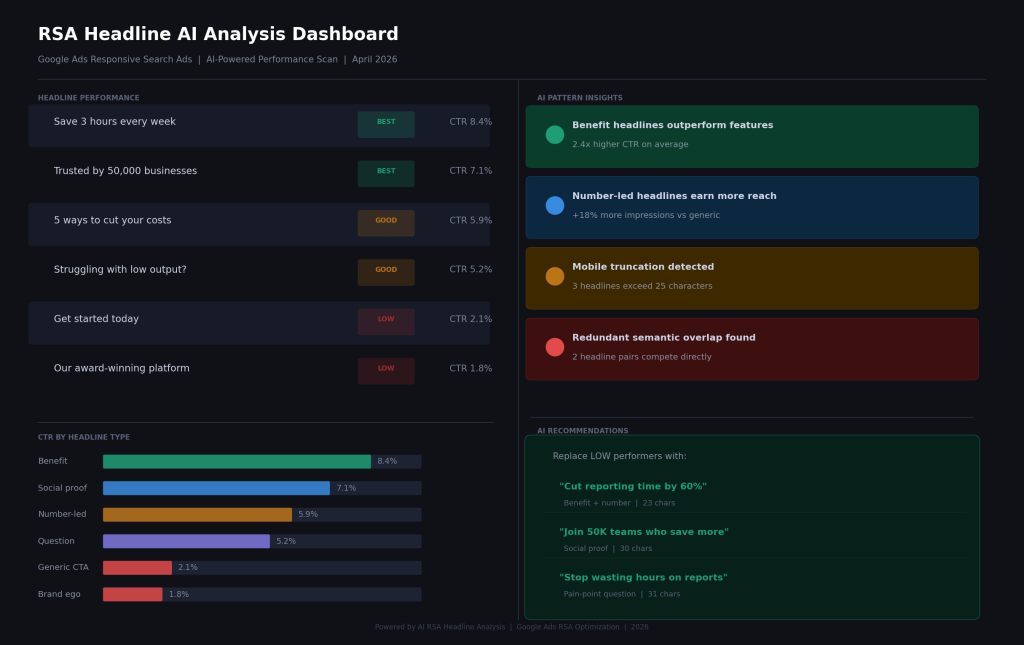
For example, an AI model can scan hundreds of headline combinations and identify that headlines beginning with a number (e.g., “5 Ways to Save on Insurance”) consistently outperform those starting with brand names, even if both carry a “Good” rating.
That is the kind of insight a human analyst would take weeks to surface manually.
What AI Actually Does in This Context
Modern AI for Google Ads optimization performs several key functions:
- Natural language processing (NLP): Classifies headlines by tone, structure, intent, and emotional appeal
- Pattern recognition: Identifies which headline types correlate with conversions
- Predictive scoring: Suggests new headlines likely to outperform current ones
- Semantic clustering: Groups similar headlines to avoid redundancy in your RSA
In short, AI connects the dots between your copy choices and your results, faster and more accurately than any spreadsheet.
Step-by-Step Guide: Using AI for RSA Headline Analysis
Step 1: Export Your RSA Asset Report from Google Ads
Start with raw data. In Google Ads:
- Go to Campaigns > Ads and Assets
- Filter by Responsive Search Ads
- Click Columns > Asset details to view headline-level data
- Export the report as a CSV
Include metrics like impressions, clicks, CTR, conversions, and asset performance labels.
Step 2: Feed the Data into an AI Tool
Several tools can handle RSA ad copy testing and analysis:
- ChatGPT or Claude (with data upload): Great for qualitative analysis and headline rewriting
- Google’s Performance Max Insights: Built-in AI signals for asset performance
- Optmyzr or Adalysis: Dedicated PPC AI platforms with RSA headline scoring
- Custom Python scripts with OpenAI API: Ideal for agencies wanting full control
Upload your CSV and prompt the AI with a specific question. For example:
“Analyze these RSA headlines. Identify which tones and structures are associated with higher CTR. Suggest 5 improvements.”
Step 3: Classify Headlines by Type
Ask the AI to categorize each headline. Common categories include:
- Feature-based: “Get Same-Day Delivery”
- Benefit-based: “Save 3 Hours Every Week”
- Social proof: “Trusted by 50,000 Businesses”
- Question-based: “Struggling with Low Conversions?”
- Urgency or FOMO: “Limited Spots, Apply Today”
Once categorized, you can compare average CTR and conversion rate by type. This reveals what your audience actually responds to.
Step 4: Identify Underperforming Patterns
Look for headlines labeled “Low” that share common traits. For instance:
- Are all your “Low” headlines generic features without clear benefits?
- Do your worst performers lack a specific number or data point?
- Are they too long for mobile display?
AI can flag these patterns instantly. Then you know exactly what to replace and why.
Step 5: Generate and Test New Headlines
Now use AI to write replacements. A good prompt looks like this:
“Write 5 RSA headlines for a B2B SaaS tool targeting marketing managers. Use a benefit-focused tone. Keep each under 30 characters. Avoid jargon.”
Replace your lowest-rated headlines with the AI’s suggestions. Then run a 2 to 4 week test before evaluating again.
Step 6: Build a Feedback Loop
This is where most advertisers stop, and where the best ones accelerate.
Set a monthly cadence:
- Export fresh asset data
- Run AI analysis
- Replace bottom performers
- Track changes in CTR and conversion rate
Over time, this feedback loop compounds. Your RSA gets sharper with every cycle.
Common Mistakes to Avoid
Mistake 1: Relying Only on Google’s Asset Labels
“Low” does not always mean bad. A headline may be labeled “Low” simply because it has not appeared often enough to gather data. Always cross-reference with impression volume before cutting a headline.
Mistake 2: Using Redundant Headlines
AI analysis often reveals that multiple headlines are semantically identical. For example, “Book a Free Demo” and “Schedule Your Free Demo” compete with each other rather than covering different intents. Use AI clustering to catch this.
Mistake 3: Ignoring Device Segmentation
A headline that works on desktop may not work on mobile, where truncation happens more often. Ask your AI tool to flag headlines exceeding 25 characters and prioritize concise alternatives for mobile-heavy accounts.
Mistake 4: Testing Too Many Variables at Once
RSA ad copy testing is only useful when you isolate variables. Do not change all 15 headlines at once. Replace 3 to 4 at a time so you can measure the impact clearly.
Mistake 5: Writing for the Algorithm, Not the Human
AI can optimize, but it still needs your input on audience psychology. Do not let AI generate headlines without a clear brief. Always provide context: the audience, their pain points, and the desired action.
Pro Tips for Smarter RSA Optimization in 2026
Use pinning strategically. Pin your top-performing headline to Position 1 to protect it from being buried. Reserve Positions 2 and 3 for ongoing testing.
Analyze search term overlap. Match headline intent to top converting search terms. AI tools can cross-reference your search term report with headline performance automatically.
Add dynamic keyword insertion thoughtfully. DKI headlines often get high impressions but low conversions if the message does not match. Ask AI to evaluate whether your DKI headlines correlate with conversion drop-offs.
Benchmark against competitors. Tools like SpyFu or Semrush can surface competitor RSA copy. Feed that data to AI and ask: “How do our headlines compare in uniqueness and clarity?”
Score emotional resonance. Tools built on NLP can rate headlines by emotional weight. High-emotion headlines (curiosity, urgency, relief) typically outperform flat, informational ones. The right emotion depends on your audience, so test carefully.
Conclusion: AI Turns RSA Confusion into Clarity
Google Ads RSA headline performance has always been a bit of a black box. Google gives you combinations. It gives you ratings. But it does not give you strategy.
AI fills that gap.
With the right tools and a consistent process, Responsive Search Ads headline analysis becomes actionable, not overwhelming. You stop guessing which headlines work and start knowing.
In 2026, the advertisers winning on Google Ads are not just writing better copy. They are using AI to learn faster, iterate smarter, and compound those gains month over month.
Start with your data. Let AI find the patterns. Then write headlines that actually earn the click.
If you like this guide you may alos like Our blog on PPC Attribution Model Comparison.
Frequently Asked Questions About AI RSA headline analysis
What is AI RSA headline analysis?
AI RSA headline analysis is the process of using artificial intelligence tools to evaluate and improve the performance of headlines in Google Ads Responsive Search Ads. AI identifies patterns in your data, such as which headline types drive more clicks or conversions, and suggests improvements based on those insights.
Does Google Ads provide AI-powered RSA headline insights?
Google offers basic AI-driven signals through its Asset Performance labels (Best, Good, Low, Learning). However, these labels lack detail. Third-party AI tools and platforms provide deeper analysis, including semantic classification, predictive scoring, and pattern detection across headline combinations.
How often should I run RSA headline analysis with AI?
A monthly review cycle works well for most advertisers. High-budget accounts or competitive industries may benefit from bi-weekly analysis. Always allow at least 2 to 4 weeks after any headline change before evaluating results.
Can AI write RSA headlines for me?
Yes. Tools like Claude, ChatGPT, and specialized PPC platforms can generate RSA headline suggestions based on your audience, offer, and performance data. However, always review AI-generated copy for brand voice, accuracy, and compliance with Google’s ad policies.
What is the biggest benefit of using AI for Google Ads RSA optimization?
Speed and pattern recognition. AI can analyze hundreds of headline combinations in seconds and identify what a human analyst might miss in hours of manual review. This allows you to make faster, more informed decisions and improve performance more consistently over time.