PPC Attribution Model Comparison: Which One Wins for Your Ad Campaigns?
You spend thousands on paid ads every month. But do you actually know which ads are driving your conversions?
Most businesses in the USA, UK, Canada, and Australia are guessing. They run Google Ads campaigns, see some results, and assume the last ad the user clicked gets all the credit. That assumption is costing them serious money.
The problem is attribution. Specifically, the PPC attribution model you choose determines how your ad platform assigns credit to each touchpoint in a customer’s journey. Choose the wrong one and you optimize for the wrong things. Choose the right one and your return on ad spend improves significantly.
This guide breaks down every major PPC attribution model comparison you need to make. It explains which models suit which businesses, which ones Google Ads uses by default, and why data-driven attribution is becoming the gold standard across markets.
What Is a PPC Attribution Model?
An attribution model is a rule that decides how much credit each ad interaction gets when a conversion happens.
Consider this scenario. A user in Toronto sees your display ad on Monday. Then they search for your brand on Wednesday and click a search ad. Finally, they visit your site directly on Friday and make a purchase.
Which ad gets the credit? The display ad introduced them to you. The search ad brought them back. Your answer to that question is your attribution model.
Understanding PPC attribution models matters because your bidding strategies, budget decisions, and campaign optimization all depend on this data. Getting attribution right is not optional. It is essential.
The 6 Main PPC Attribution Models Explained
1. Last-Click Attribution
Last-click attribution gives 100% of the credit to the final ad a user clicked before converting.
This is the oldest and most commonly used model. Google Ads used it as the default for years, and most advertisers in the USA and UK are still using it without realising there are better options.
When it works: Last-click is useful when your sales cycle is extremely short. If someone searches, clicks, and buys within minutes, the last click probably deserves all the credit.
When it fails: Last-click completely ignores every touchpoint that came before the final click. If your display ads build awareness or your video ads warm up prospects, last-click attribution makes those campaigns look worthless. Businesses running multi-channel campaigns in competitive markets like Australia and Canada often undervalue top-funnel channels because of last-click bias.
2. First-Click Attribution
First-click attribution gives 100% of the credit to the very first ad a user interacted with.
This model does the opposite of last-click and ignores everything that happened between the first touch and the conversion.
When it works: First-click attribution is valuable when your goal is brand awareness. If you want to understand which campaigns introduce new customers to your business, first-click gives you that view.
When it fails: First-click completely ignores the closing touchpoints, so a campaign that nurtures and converts users looks invisible in your data.
3. Linear Attribution
Linear attribution spreads the credit equally across every touchpoint in the customer journey.
If a user clicked four ads before converting, each ad gets 25% of the credit. This feels fairer than first-click or last-click on the surface.
When it works: Linear works well for businesses with longer sales cycles. It is also useful when you want a broad picture of which channels are involved in conversions, not just which one closed the deal.
When it fails: Not all touchpoints are equally valuable. Giving the same credit to a YouTube pre-roll ad that someone skipped after three seconds and to a high-intent search ad creates misleading data.
4. Time-Decay Attribution
Time-decay attribution gives more credit to the touchpoints that happened closest to the conversion.
The ad a user clicked two days ago gets more credit than the ad they saw two weeks ago. This model recognises that recent interactions often have a stronger influence on the buying decision.
When it works: Time-decay works well for businesses running promotions or flash sales. In markets like the UK and Australia where seasonal campaigns are common, this model captures the influence of recent urgency-driven ads effectively.
When it fails: Time-decay still ignores the role of awareness campaigns that happen early in the journey. You may end up cutting budget from top-of-funnel campaigns that are quietly driving demand.
5. Position-Based Attribution (U-Shaped)
Position-based attribution, sometimes called the U-shaped model, gives 40% of the credit to the first touchpoint, 40% to the last touchpoint, and shares the remaining 20% equally across the middle.
This model acknowledges that both the beginning and the end of the customer journey matter.
When it works: Position-based attribution suits businesses that care equally about acquisition and conversion. It works well for lead generation agencies or any business running awareness plus retargeting campaigns simultaneously.
When it fails: The 40/20/40 split is arbitrary. You are still making assumptions about credit distribution rather than measuring it.
6. Data-Driven Attribution
Data-driven attribution uses machine learning to analyse your actual conversion data and assign credit based on real patterns.
Instead of applying a fixed rule, Google’s algorithm studies which ad sequences actually lead to conversions versus which ones do not. Credit is allocated dynamically based on measured impact. According to Google’s official attribution documentation, at least 300 conversions within a 30-day period are recommended for the model to function accurately.
When it works: Data-driven attribution is the most accurate model available when you have sufficient conversion data. Google recommends at least 300 conversions in a 30-day period to use this model effectively. Businesses in high-volume markets like the USA and Canada benefit most from this approach.
When it fails: Data-driven attribution requires data. If your account is new or your conversion volume is low, the model will not have enough signal to work properly.
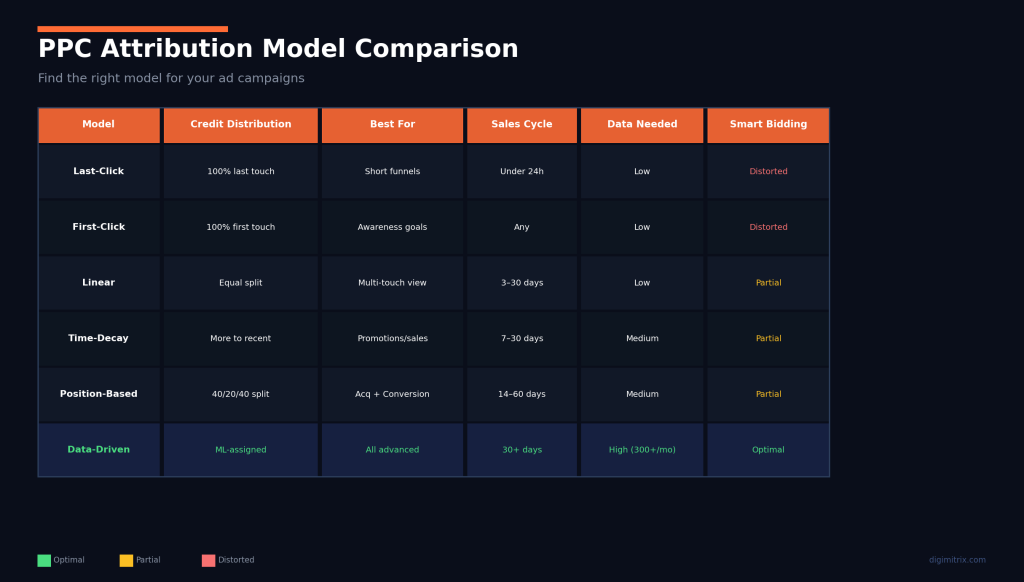
PPC Attribution Model Comparison Table
How Attribution Models Affect Your Bidding Strategy
Your attribution model does not just tell you where credit goes. It directly controls how Google’s Smart Bidding algorithm optimises your campaigns.
Smart Bidding reads your attributed conversion data to decide which keywords to bid higher on and which to scale back. If your attribution model gives all credit to the last click, Google bids aggressively on bottom-funnel branded keywords and reduces spend on discovery keywords, even if those discovery keywords are what drives initial intent.
This is a hidden attribution trap that costs advertisers in the USA significant budget every year. According to Google’s own attribution documentation, switching from last-click to data-driven attribution can reveal significant undervaluation of top-of-funnel keywords.
Changing your attribution model changes your Smart Bidding behaviour. Treat attribution as a strategic decision, not just a reporting preference.
Attribution Models and the Customer Journey in 2025
Customer journeys have become longer and more complex. Users in the UK typically research a product across five to seven touchpoints before buying. Buyers in Australia often cross devices multiple times, starting on mobile and converting on desktop.
North American shoppers in the USA and Canada increasingly use voice search, YouTube, and social discovery ads before ever reaching a search results page.
These behaviours make last-click attribution especially dangerous. The industry is moving fast toward data-driven and AI-assisted attribution models as a result.
Google officially deprecated several rules-based models, including first-click, linear, time-decay, and position-based, for new campaigns starting in 2023. Most new Google Ads accounts now default to data-driven attribution automatically.
However, many established accounts are still running older models without knowing it. If you set up your account before 2023 and have not audited your attribution settings, you are likely making budgeting decisions on flawed data.
How to Choose the Right Attribution Model for Your Business
Picking the right model depends on three factors: your sales cycle length, your conversion volume, and your campaign mix.
If your sales cycle is under 24 hours, last-click attribution may still give you accurate enough data. E-commerce stores selling low-cost impulse products often fit this profile.
If your sales cycle is between 3 and 30 days, linear or position-based attribution will give you a more balanced picture. SaaS businesses, service providers, and B2B companies in the UK and Canada often fall into this range.
If your sales cycle is longer than 30 days, time-decay attribution may help highlight which recent touchpoints were driving urgency. Data-driven attribution is still the stronger choice wherever your conversion volume allows it.
If you have more than 300 conversions per month, move to data-driven attribution as soon as possible. This is especially true for e-commerce advertisers in the USA running Performance Max campaigns alongside standard search.
Common Attribution Mistakes That Drain Your Ad Budget
Even experienced advertisers make attribution errors. Understanding these mistakes helps you avoid wasting budget on the wrong campaigns.
Mistake 1: Using last-click on long sales cycles This is the most expensive mistake in PPC management. Last-click attribution kills top-funnel campaigns by making them look like they drive no conversions. You cut the budget on awareness campaigns, your pipeline dries up, and three months later you wonder why conversion volume dropped.
Mistake 2: Not aligning attribution with your bidding strategy Running Target CPA bidding with last-click attribution and then switching to data-driven attribution without adjusting your CPA targets will cause significant disruption to your account. The volume and cost data will look completely different. Always adjust your targets when you change your attribution model.
Mistake 3: Comparing campaigns with different attribution windows Some campaigns use 30-day attribution windows. Others use 7-day windows. Comparing their performance directly is misleading. In Australian and Canadian accounts where campaign structures vary widely across teams, inconsistent windows create reporting confusion.
Mistake 4: Ignoring view-through conversions Display and YouTube campaigns drive view-through conversions, where a user sees your ad but does not click, then converts later through another channel. Most advertisers in the UK and USA ignore view-through data entirely. This undervalues upper-funnel campaigns significantly.
Attribution in Google Ads vs Microsoft Advertising
Google Ads and Microsoft Advertising both offer similar attribution models, but there are important differences worth noting.
Microsoft Advertising still supports all rules-based attribution models and has not deprecated them as Google has. If you run significant spend on Microsoft Bing Ads, which holds around 10 to 12 percent market share in the USA and higher in certain UK demographics, you need a separate attribution strategy for that platform.
Cross-platform attribution adds further complexity. A user who sees a Microsoft Bing ad on Monday and converts through Google on Wednesday will not appear in either platform’s attribution data as a full-picture conversion. Advertisers who rely solely on in-platform attribution always undercount the actual cross-platform assist value.
Third-party attribution tools like Northbeam, Triple Whale, or Google Analytics 4 help solve this cross-platform problem. Using GA4’s attribution reports alongside your Google Ads data gives you a more complete picture across all your paid channels.
The Decision Flowchart: How to Pick Your PPC Attribution Model
(Insert flowchart image here. Alt text: “Decision flowchart for choosing the right PPC attribution model based on sales cycle length, conversion volume, and campaign mix.”)
Start here: What is your average sales cycle?
- Under 24 hours: Last-click may be acceptable. Check conversion volume.
- 3 to 30 days: Consider linear or position-based attribution.
- Over 30 days: Move toward data-driven attribution if volume allows.
- Over 300 conversions per month: Use data-driven attribution immediately.
How Digimitrix Approaches Attribution for Clients
At Digimitrix, we audit attribution settings before touching any other part of a client’s account. Our Google Ads management process starts with identifying which attribution model is currently active across every campaign, then checking whether it aligns with the client’s sales cycle and campaign mix.
Our process starts with identifying which attribution model is currently active across every campaign in the account. Then we check whether the model aligns with the client’s sales cycle and campaign mix. After that, we run a 30-day parallel comparison, keeping the existing model active in reporting while previewing what data-driven attribution would show.
This parallel approach lets us see the difference in credit distribution before making any bid strategy changes. Our clients never experience a sudden drop in reported conversions when switching models.
Beyond Google Ads, we integrate GA4 attribution reports to capture cross-channel assist data. This is particularly important for our clients in the USA running omnichannel campaigns across Search, Performance Max, YouTube, and paid social simultaneously.
Key Attribution Terms to Know
Conversion window refers to the number of days after an ad click during which a conversion can be counted. Attribution models interact directly with your conversion window settings. A longer window captures more assisted conversions but can also inflate reported numbers.
View-through conversion counts a conversion when someone saw your ad but did not click, then later converted through a different channel. These are separate from click-through conversions and are controlled independently in your settings.
Cross-device attribution tracks users who interact with your ads across multiple devices. A user who clicks a search ad on their iPhone and converts on their MacBook later is a cross-device conversion. Google’s signed-in user data helps track this, but coverage is never 100%.
Impression-based attribution is an advanced concept where even ad impressions receive partial credit. This is relevant for brand awareness measurement and for evaluating Display and YouTube campaign ROI.
Attribution window vs. lookback window: Your attribution window defines how long after a click a conversion can be credited. Your lookback window defines how far back in the customer journey the model looks for touchpoints to assign credit to.
What Changes When You Switch Attribution Models
Switching your attribution model will change the reported performance of your campaigns. This is expected and normal, but it surprises many advertisers the first time they see it.
When you switch from last-click to data-driven attribution, you will typically see top-of-funnel keywords gain more credited conversions. At the same time, bottom-funnel branded keywords will lose some attributed credit. This does not mean your branded campaigns are suddenly performing worse. It means the data is now more accurately reflecting how credit was already being shared.
Your Smart Bidding targets will also need adjustment. If Target CPA was set at $50 under last-click and your data-driven model now attributes more conversions across more keywords, your effective CPA may look lower than before. Resist the urge to immediately raise your targets. Give Smart Bidding three to four weeks to learn from the new attribution signal before making changes.
The transition period typically takes 30 to 60 days for bidding algorithms to fully stabilise. During this period, monitor impression share, conversion volume, and average CPC closely rather than focusing purely on CPA.
Attribution Benchmarks by Industry and Market
Different industries see different attribution patterns. Knowing these benchmarks helps you set realistic expectations.
E-commerce businesses in the USA typically see 60 to 70 percent of conversions attributed to the last two touchpoints under a data-driven model. Their lower-funnel campaigns genuinely do carry most of the closing weight. Data-driven attribution often does not dramatically shift budget away from branded search in e-commerce.
B2B software companies in the UK and Canada, however, often find that data-driven attribution reveals significant value in display and content-targeting campaigns that never registered conversions under last-click. Sales cycles of 45 to 90 days mean many touchpoints happen across multiple weeks.
Service businesses in Australia running local PPC campaigns often have very short sales cycles. A user needs a plumber today and calls within minutes of clicking an ad. For these businesses, last-click attribution remains a reasonable choice.
Retail and hospitality brands across all four markets benefit most from seasonal attribution model reviews. Time-decay attribution during peak promotional periods and data-driven attribution during non-peak periods gives the most accurate picture year-round.
Attribution and Google Analytics 4 Integration
Google Analytics 4 uses a different default attribution model than Google Ads. This discrepancy is one of the most common sources of confusion in digital marketing reporting.
Google Ads defaults to data-driven attribution at the campaign level. GA4, by default, uses a data-driven model as well, but measures it differently because GA4 captures sessions across all channels, not just paid ads.
Comparing Google Ads conversion numbers directly to GA4 goal completions almost always shows a discrepancy. Neither number is wrong. They are simply measuring different things with different lookback windows and channel scopes.
The solution is to use GA4 as your cross-channel source of truth and Google Ads as your in-channel optimisation tool. Aligning the attribution settings in both platforms reduces the gap but rarely eliminates it completely.
For advertisers in the USA and UK running significant budgets across Google, Meta, and programmatic display, a dedicated marketing attribution platform becomes necessary to reconcile data across all channels. Tools like Northbeam, Rockerbox, or custom GA4 explorations provide this layer.
How to Audit Your Current Attribution Model in Google Ads
Auditing your attribution model in Google Ads takes less than five minutes. Here is exactly how to do it.
- Log into your Google Ads account and navigate to Tools and Settings.
- Click Measurement and select Conversions.
- Click on each conversion action in your account.
- Look for the attribution model setting in the column on the right.
If you see “Last click” next to any conversion action that tracks purchase or lead events, you have an immediate optimisation opportunity. Switching to data-driven attribution for these actions, assuming your volume qualifies, is one of the highest-impact changes you can make with zero additional spend.
Also check whether your conversion actions are set as “Primary” or “Secondary.” Only Primary conversion actions feed into Smart Bidding. If your most important conversion event is set to Secondary by mistake, your entire bidding strategy is optimising for the wrong goal.
Frequently Asked Questions About PPC Attribution Models
Q: What is the best PPC attribution model for Google Ads? Data-driven attribution is the best model for most Google Ads accounts with sufficient conversion volume. It uses machine learning to assign credit based on actual user behaviour rather than fixed rules. Google itself recommends this model for accounts generating 300 or more conversions per month.
Q: What attribution model does Google Ads use by default? Since 2023, Google Ads defaults to data-driven attribution for new accounts and campaigns. However, accounts created before 2023 may still be using last-click attribution unless they have been manually updated.
Q: How does changing my attribution model affect Smart Bidding? Smart Bidding reads your attributed conversion data to decide how to bid. Changing your attribution model changes which keywords and campaigns receive credit for conversions. This directly affects how Google allocates your budget. Always review and adjust your CPA or ROAS targets after switching models, and allow four to six weeks for Smart Bidding to stabilise.
Q: Can I use different attribution models for different campaigns? Attribution models in Google Ads are set at the conversion action level, not the campaign level. So if you change the attribution model on a conversion action, it applies to every campaign tracking that action. You can, however, create separate conversion actions with different models if your reporting strategy requires it.
Q: What is the difference between last-click and data-driven attribution? Last-click attribution gives 100% of conversion credit to the final ad a user clicked before converting. Data-driven attribution uses machine learning to distribute credit across all touchpoints based on which ones actually influenced the conversion. For most businesses, data-driven attribution provides a more accurate picture of campaign performance.
Q: How many conversions do I need for data-driven attribution to work? Google recommends at least 300 conversions within a 30-day period for data-driven attribution to function accurately. If your account falls below this threshold, the model may not have enough signal and could produce unreliable credit distribution.
Q: Is first-click or last-click attribution better for brand awareness campaigns? First-click attribution is better for measuring the impact of brand awareness campaigns because it credits the initial touchpoint that introduced the user to your brand. Last-click attribution would assign all credit to the final touchpoint and make awareness campaigns appear to drive no value.
Q: Why do my Google Ads and Google Analytics 4 conversion numbers not match? Google Ads and GA4 measure conversions differently. Google Ads counts a conversion based on the ad click and your campaign-level attribution model. GA4 captures sessions across all channels with its own lookback window and scope. Using GA4 as a cross-channel source of truth alongside Google Ads in-platform data is the recommended approach for reconciling the difference.
Final Thoughts: Attribution Is Your Competitive Edge
Most advertisers in the USA, UK, Canada, and Australia are still running campaigns on outdated attribution models. They are making budget decisions based on incomplete data and leaving performance on the table.
Switching to data-driven attribution, or even just understanding the differences between the models available to you, gives you an immediate edge over competitors who have not had this conversation yet.
Attribution is not the most exciting topic in PPC, but it is one of the most impactful. Getting attribution right means your bidding strategy gets better data, your budget flows to the campaigns that actually drive growth, and your reporting tells an accurate story to stakeholders.
If you want help auditing your attribution model and aligning it with your campaign strategy, the team at Digimitrix specialises in exactly this. We work with businesses across the USA, UK, Canada, and Australia to build PPC systems that perform based on real data, not assumptions.