What Are AdWords Management Services? A Complete Guide for 2026
Running a successful Google Ads campaign takes more than just setting a budget and choosing a few keywords. It requires strategy, constant monitoring, and data-driven decisions. That is exactly where AdWords management services come in.
This guide explains what AdWords management services are, how they work, why businesses need them, and what a professionally managed campaign looks like from start to finish.
What Are AdWords Management Services?
AdWords management services refer to the professional management of Google Ads campaigns on behalf of a business. A qualified PPC specialist or digital marketing agency handles everything. They research keywords, write ad copy, manage budgets, monitor performance, and optimise campaigns to achieve the best possible return on investment (ROI).
Google rebranded Google AdWords as Google Ads in 2018, but many marketers still use “AdWords” as a common term. So when you see “AdWords management services,” it typically means full Google Ads campaign management.
Why Do Businesses Need Professional AdWords Management?
Many businesses try to manage Google Ads on their own. Some succeed. Most, however, end up wasting a significant portion of their budget on poor targeting, weak ad copy, and mismanaged bids.
Here is why professional Google Ads management makes a measurable difference:
1. Reducing wasted ad spend Without proper negative keyword lists and audience targeting, ads appear for irrelevant searches. A skilled PPC manager reduces wasted spend by up to 30% in the first month of management.
2. Better Quality Scores mean lower costs Google uses Quality Score to measure the relevance of your ad, keyword, and landing page. A higher Quality Score lowers your cost-per-click (CPC). Professionals know how to improve Quality Score consistently.
3. Smarter bidding strategies Google Ads offers several bidding strategies, Target CPA, Target ROAS, Maximise Clicks, and Enhanced CPC. Choosing the wrong one wastes money fast. Experienced managers match the right bidding strategy to your business goal.
4. Continuous A/B testing Professional managers run ongoing split tests on headlines, descriptions, and landing pages. This improves click-through rate (CTR) and conversion rate (CVR) over time.
5. Faster data-driven decisions Professionals use Google Analytics and Google Ads conversion tracking together. They identify which campaigns, ad groups, and keywords actually drive revenue, and which ones drain the budget.
The 5-Step AdWords Management Process
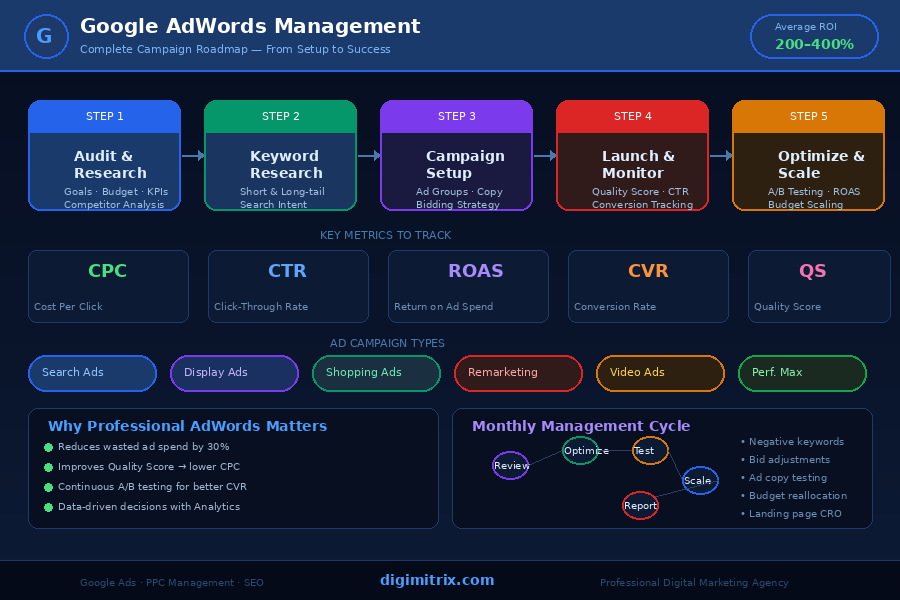
A well-structured PPC management service follows a clear process. Below is how a professional campaign management cycle works.
Step 1: Account Audit and Business Research
The first step in any Google Ads campaign management engagement is a thorough audit.
A specialist reviews your existing account (or sets up a new one), examines your competitors, and identifies opportunities. They also define clear campaign objectives. Common goals include:
- Generating leads
- Driving online sales
- Increasing phone calls
- Building brand awareness
At this stage, they set key performance indicators (KPIs) and decide on a realistic monthly ad budget.
Step 2: Keyword Research and Match Type Strategy
Keyword research is the foundation of every successful paid search management campaign.
A good keyword strategy includes:
- Short-tail keywords — high search volume, broader intent (e.g. “digital marketing agency”)
- Long-tail keywords — lower search volume, stronger buying intent (e.g. “AdWords management services for small business”)
- Negative keywords — terms you do not want to trigger your ads
Keyword match types (broad, phrase, exact) also play a major role. Broad match reaches more users. Exact match targets specific searches. Phrase match sits in between. Professional managers use a balanced mix to maximise reach while controlling cost.
You can use Google’s Keyword Planner to explore keyword ideas.
Step 3: Campaign Structure and Ad Copy Creation
After research, the next step is building the campaign structure. A well-organised account has:
- Clear campaign categories (e.g. one campaign per product or service)
- Tightly themed ad groups (each ad group targets 5–15 closely related keywords)
- Multiple ad variations per ad group (for testing purposes)
Ad copywriting is an art in itself. Every headline and description must be relevant, compelling, and include the primary keyword naturally. Strong calls to action like “Get a Free Quote,” “Book a Demo,” or “Start Today”, push users to convert.
Responsive Search Ads (RSAs) are now the default format. They allow up to 15 headlines and 4 descriptions. Google automatically tests combinations and shows the best-performing versions.
Step 4: Campaign Launch and Performance Monitoring
Once campaigns go live, the real work begins.
In the first 30 days, a PPC manager watches:
- Impression share — how often ads appear vs. how often they could
- Click-through rate (CTR) — percentage of users who click the ad
- Cost-per-click (CPC) — what each click costs
- Conversion rate (CVR) — percentage of clicks that become leads or sales
- Cost-per-acquisition (CPA) — total cost to generate one lead or sale
Conversion tracking must be set up correctly before launch. Without it, you cannot measure what actually works.
Step 5: Ongoing Optimisation and Scaling
PPC campaign optimisation is not a one-time task. It is a continuous cycle.
Every month, a professional manager will:
- Add new negative keywords based on search term reports
- Pause underperforming keywords and ads
- Test new ad copy variations
- Adjust bids for different devices, locations, and times of day
- Review landing page performance and suggest improvements
- Scale budgets for campaigns delivering strong ROAS
This monthly cycle is what separates a professionally managed campaign from a neglected one.
Types of Google Ads Campaigns
A complete AdWords management service covers all major campaign types:
Search Ads Text-based ads that appear in Google search results when users search for relevant keywords. These are the most common and highest-intent campaign type.
Display Ads Image and banner ads that appear across millions of websites in the Google Display Network. These work well for brand awareness and retargeting.
Shopping Ads Product listing ads (PLAs) that show product images, prices, and store names directly in search results. Essential for e-commerce businesses.
Remarketing Campaigns Ads that target users who previously visited your website. Remarketing keeps your brand in front of warm audiences and significantly improves conversion rates.
Video Ads Ads on YouTube and other video platforms within the Google network. Ideal for brand storytelling and product demonstrations.
Performance Max Campaigns Google’s newest campaign type. Performance Max uses machine learning to show ads across all Google channels Search, Display, YouTube, Gmail, and Discover from a single campaign. Learn more from Google’s Performance Max overview.
Key Metrics in Google Ads Management
Understanding the right metrics is essential. Here are the most important ones in any Google Ads management engagement:
| Metric | What It Measures | Why It Matters |
|---|---|---|
| CTR | % of impressions that become clicks | Shows ad relevance |
| CPC | Cost per individual click | Measures budget efficiency |
| Quality Score | Ad, keyword, and landing page relevance (1–10) | Affects ad position and CPC |
| Conversion Rate | % of clicks that convert | Shows landing page effectiveness |
| ROAS | Revenue generated per rupee/dollar spent on ads | Measures campaign profitability |
| Impression Share | % of total available impressions won | Shows how competitive your ads are |
What Does an AdWords Management Service Cost?
Pricing models vary by agency and scope. Common structures include:
- Flat monthly retainer — a fixed fee regardless of ad spend
- Percentage of ad spend — typically 10–20% of your monthly Google Ads budget
- Performance-based pricing — fees tied to specific conversion targets
For small businesses, professional management usually starts from a few thousand rupees per month. For mid-sized companies with higher budgets, comprehensive Google AdWords management can include full-funnel strategy, landing page optimisation, and monthly reporting.
The key question is not “how much does management cost” it is “how much money am I losing without professional management.”
AdWords Management for Different Business Types
Small and medium businesses (SMBs) Local service businesses (plumbers, dentists, law firms) benefit greatly from geo-targeted Search campaigns with call extensions. Local AdWords campaigns drive direct phone calls and store visits.
E-commerce businesses Shopping campaigns and Dynamic Remarketing are the core tools. A well-managed Shopping campaign can deliver ROAS of 400–800% in competitive categories.
B2B companies Lead generation campaigns with strong landing pages and CRM integration. LinkedIn audience targeting can also be layered into Google Ads via Customer Match.
Startups Brand awareness campaigns on Display and YouTube build recognition quickly. Paired with remarketing, startups can compete with larger brands on a controlled budget.
Common AdWords Management Mistakes to Avoid
Even experienced advertisers make these errors. Professional management prevents them:
Targeting too broadly Using only broad match keywords without negatives wastes budget on irrelevant traffic.
Ignoring landing page experience Sending all traffic to the homepage instead of a dedicated, relevant landing page is one of the most common conversion killers.
Not using ad extensions Sitelinks, callouts, call extensions, and structured snippets improve CTR significantly. Skipping them leaves money on the table.
Setting and forgetting campaigns Google Ads is not set-and-forget. Campaigns that are not reviewed weekly deteriorate in performance.
Tracking conversions incorrectly Without proper conversion tracking, you cannot make smart budget decisions. Every campaign must have verified conversion actions before launch.
How to Choose the Right AdWords Management Agency
Not all PPC agencies are equal. Here are the key things to look for when choosing a partner for paid search management:
- Google Partner or Premier Partner certification shows the agency meets Google’s performance and spend requirements
- Transparent reporting you should receive clear monthly reports showing exactly what happened and why
- Dedicated account manager one point of contact who knows your account inside and out
- Proven case studies ask for examples of real results in your industry
- No long lock-in contracts a confident agency does not need to trap you in a 12-month contract
Google’s Partner directory lets you search for certified agencies by location and specialisation.
At Digimitrix, we manage Google Ads campaigns for businesses across multiple industries. Our approach is transparent, data-driven, and focused on measurable results. Visit digimitrix.com to learn more about our PPC and Google Ads management services.
AdWords Management and SEO: Better Together
Many businesses treat Google Ads and SEO as separate activities. In reality, they work best together.
Google Ads gives you instant visibility while your SEO strategy builds organic rankings. The data from your PPC campaigns — best-performing keywords, highest-converting landing pages, audience demographics — informs and improves your SEO efforts.
A good digital marketing agency manages both channels in a coordinated way. This combined strategy delivers faster growth and stronger long-term results.
Frequently Asked Questions
What is the difference between Google Ads and Google AdWords? Google AdWords was the original name of Google’s advertising platform. Google renamed it Google Ads in 2018. The two terms refer to the same platform.
How long does it take to see results from AdWords management? Most campaigns show meaningful data within the first 30 days. Optimisation takes 60–90 days to show consistent improvement. Full campaign maturity typically takes 3–6 months.
Can I manage Google Ads myself? Yes, anyone can create and run a Google Ads account. However, without professional management, most accounts suffer from wasted spend, poor targeting, and low Quality Scores. Professional management pays for itself through better performance.
What is a good ROAS for Google Ads? A ROAS of 4:1 (earning four dollars for every dollar spent) is a common benchmark. However, target ROAS depends heavily on your industry, margins, and business model.
Do I need a large budget for Google Ads? No. Campaigns can start with modest budgets. What matters more than budget size is how well the campaign is managed. A small, well-optimised campaign outperforms a large, poorly managed one every time.
Final Thoughts
Google AdWords management services are not a luxury they are a necessity for businesses that want to compete in paid search. The platform is powerful, but it rewards those who understand it deeply and manage it consistently.
Whether you are a startup running your first campaign or an established business looking to scale, professional PPC management services give you a clear advantage. They save time, reduce wasted spend, and deliver measurable results.
If you want to explore how professional Google Ads campaign management can work for your business, Digimitrix offers tailored AdWords management services for companies of all sizes.
Published by Digimitrix Digital Marketing Agency | Google Ads · PPC Management · SEO