What Are Geofencing Ads?
Geofencing ads are location-based digital ads. They target users when those users enter a defined geographic boundary called a geofence.
When a person crosses that virtual boundary, they receive a targeted ad. This could be a push notification, a display ad, or a social media ad.
The geofence is set around a specific location. That location could be a store, an event venue, a competitor’s premises, or even a city block.
Geofencing ads work because they reach the right person at the right time in the right place. That combination is rare in digital marketing. Furthermore, it is increasingly valuable in 2026.
According to research by MarketsandMarkets, the location-based advertising market is expected to surpass $200 billion globally by 2026. Geofencing sits at the center of that growth.
How Geofencing Ads Work
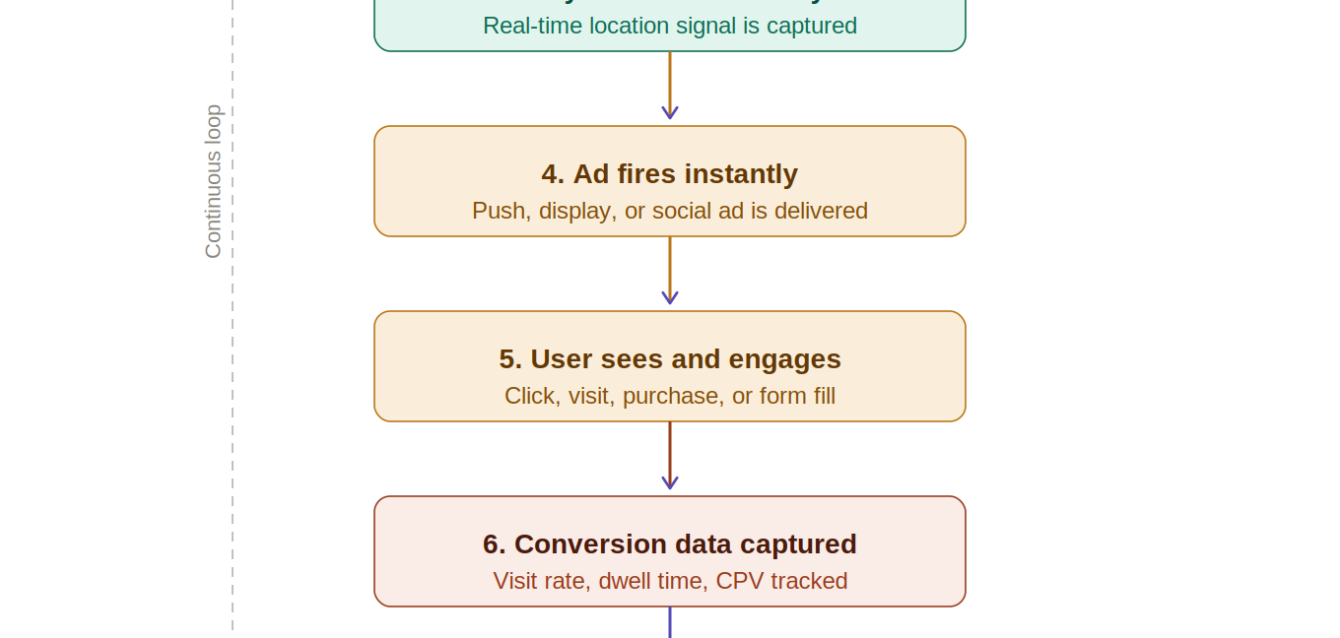
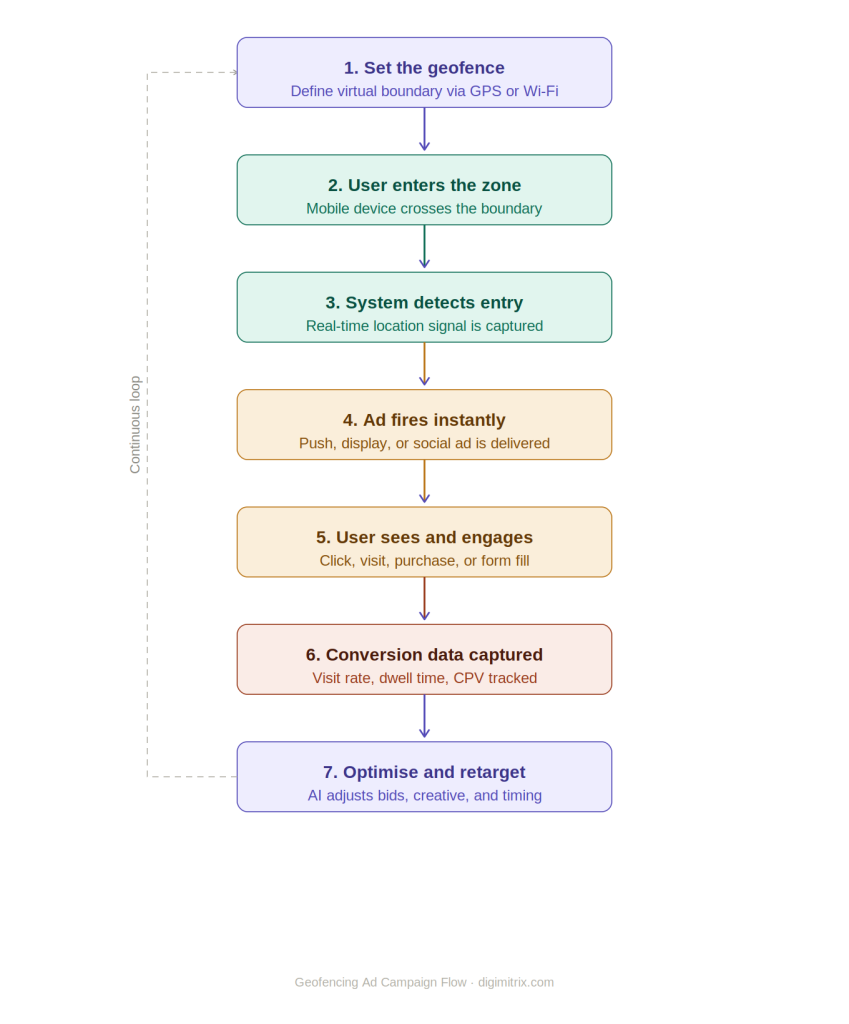
The process follows a clear sequence. First, a marketer sets a virtual boundary around a location using GPS, Wi-Fi, RFID, or cellular data. Second, a user enters that boundary with a mobile device. Third, the system detects the entry. Fourth, the ad fires.
All of this happens in near real-time. Therefore, the message reaches the user when their intent is at its highest.
Here is a practical example. A coffee brand places a geofence around every competitor café in a city. When a user enters a competitor’s location, that user immediately receives a push notification offering a discount at the nearest outlet. As a result, the brand intercepts foot traffic at the exact moment a purchase decision is forming.
This precision is what makes geofencing ads so powerful in digital marketing.
Key Types of Geofencing Ads in 2026
Digital marketers use several types of geofencing ads. Each type serves a different purpose.
Competitor geofencing places a fence around a rival business. Marketers use it to pull customers away at the point of decision.
Event-based geofencing targets attendees at conferences, sports games, concerts, and trade shows. Audiences at events are already assembled and engaged, which raises conversion probability significantly.
Venue retargeting captures users who visited a location and retargets them for days or weeks afterward. Extending the campaign window this way produces more touchpoints from a single geofence entry.
Hyperlocal geofencing uses extremely tight boundaries, sometimes as small as 100 metres. Consequently, it delivers very precise targeting for retailers, restaurants, and service businesses.
Geo-conquesting is the most aggressive form. It combines competitor targeting with real-time offer delivery. In 2026, geo-conquesting has become a core tactic for fast-moving consumer goods brands.
Why Geofencing Ads Dominate Digital Marketing in 2026
The landscape of digital marketing has shifted considerably. Privacy regulations have tightened. Third-party cookies are largely gone. Audiences are harder to reach through traditional display advertising.
Geofencing ads solve this problem without relying on cookies or third-party data. Location is used as the targeting signal instead. That signal is strong, consent-compliant, and directly tied to purchase intent.
Mobile device usage continues to rise as well. As of 2026, mobile accounts for over 65% of global digital ad spend according to Statista. Geofencing is inherently mobile-first, which makes the timing for this channel ideal.
Beyond reach, geofencing ads offer superior data. Marketers gain foot traffic attribution, dwell time insights, and return visit tracking. These metrics were difficult or impossible to access through traditional digital advertising formats.
For businesses of all sizes, this data translates into better decisions, stronger ROI, and more relevant campaign creative.
Geofencing Ads vs Traditional Location Targeting
Many digital marketers confuse geofencing with standard location targeting. The difference matters.
Traditional location targeting uses broad geographic parameters such as country, city, or zip code. It reaches everyone in that area regardless of their actual physical behaviour.
Geofencing targeting responds to real-world movement instead. It reacts when someone physically moves through a defined space. Therefore, it ties the digital ad experience directly to physical behaviour.
Geofencing can also layer behavioural and demographic signals on top of location signals. In 2026, platforms like Google and Meta allow marketers to combine geofence entry events with audience profile data. This produces highly specific targeting scenarios.
For example, a luxury car brand can target users who enter a premium shopping district, fit a certain income bracket, and have previously browsed vehicle content online. That level of specificity was not possible with older location-targeting methods.
Setting Up a Geofencing Campaign: Step by Step
A successful geofencing campaign requires structured planning. Follow this sequence to build campaigns that perform.
Step 1: Define Your Campaign Goal
Decide what the campaign must achieve. Options include driving foot traffic, increasing competitive conversions, or building brand awareness at an event. The goal shapes everything that follows.
Step 2: Choose the Right Locations
Select locations based on your audience’s real behaviour. Use competitor addresses, high-traffic venues, transit hubs, or industry events. Each location should represent a moment of genuine relevance.
Step 3: Set the Geofence Radius
Smaller radiuses produce higher intent but smaller reach. Larger radiuses produce more impressions but lower relevance. For retail, a radius of 100 to 500 metres generally works best. For events, a tighter boundary around the venue entry point is more effective.
Step 4: Build Location-Specific Creatives
Generic ads underperform in geofencing campaigns. Create messaging that speaks directly to the moment of entry. If someone is standing near a competitor’s store, your ad should acknowledge that context without stating it explicitly.
Step 5: Set Your Timing Parameters
Decide when ads fire. Consider whether to target business hours, event windows, or only after a minimum dwell time. Setting dwell time minimums of at least five minutes removes drive-by impressions and improves quality.
Step 6: Add Conversion Tracking and Attribution
Link geofence entry events to downstream actions. Track in-store visits, app downloads, online purchases, and form completions. Closing this loop between physical presence and digital conversion is essential for campaign optimisation.
Geofencing Ads and the 2026 Privacy Landscape
Privacy is the dominant conversation in digital marketing right now. Geofencing sits in a complex position within that conversation.
On one hand, location data is sensitive. Regulations like GDPR in Europe, CCPA in California, and emerging frameworks across Asia Pacific require informed consent before location tracking begins.
Properly implemented geofencing campaigns rely on aggregated, anonymised data collected through apps and browsers where users have already opted in. Platforms that serve geofencing ads, including Google Display Network, programmatic DSPs, and Meta, operate within consent frameworks.
Marketers must work within these frameworks carefully. Partnering with compliant data providers, avoiding personally identifiable location data storage, and communicating transparently with audiences are all non-negotiable steps.
The good news is that privacy-compliant geofencing still works extremely well. Consent-based location signals are often stronger and more reliable than the cookie-based signals they replace.
At Digimitrix, we build all geofencing campaigns on privacy-first principles to ensure both performance and compliance.
Geofencing Ads for Small and Medium Businesses
Geofencing is not exclusively for enterprise brands. In 2026, the cost of running geofencing campaigns has fallen significantly. Platforms and self-serve tools have made the channel accessible to businesses with modest budgets.
A local restaurant can geofence the surrounding three blocks and send lunch promotions to nearby office workers at 11:30 AM. A dental clinic can geofence rival practices and send appointment offers. A boutique retail store can geofence a nearby weekend market and target shoppers with collection announcements.
The key advantage for small businesses is hyper-relevance. Local businesses know their neighbourhoods well. Geofencing allows that knowledge to become a competitive advantage in digital marketing.
Geofencing campaigns for small businesses also often deliver faster ROI than broader digital channels. Because the targeting is so precise, conversion rates are higher and wasted spend is lower.
Our team at Digimitrix works with businesses at every scale to implement geofencing strategies that deliver measurable returns.
Industry Applications of Geofencing Ads
Geofencing applies across virtually every industry. Certain sectors, however, gain exceptional value from location-based targeting.
Retail and eCommerce uses geofencing to drive in-store visits, intercept competitor traffic, and deliver time-sensitive offers. Retailers also use post-visit retargeting to recover browsers who entered a store but did not purchase.
Healthcare and dental practices use geofencing around competitor clinics, hospitals, and specialist offices. Pharmacies also serve as a strong intent signal for healthcare marketers looking to reach health-conscious audiences.
Automotive dealerships geofence competitor showrooms and target users who spend significant dwell time at those locations. Service departments separately target users at independent mechanics to offer maintenance packages.
Hospitality and restaurants geofence transit hubs, tourist attractions, and office districts to reach people near the moment of a food decision. Hotels target airports and conference centres for the same reason.
Events and entertainment use geofencing to drive ticket sales among people already in proximity of the venue, promote last-minute availability, and cross-promote related events.
Real estate targets users who visit open inspections or walk through target neighbourhoods. Agents retarget these users with listings for days after the initial visit.
Geofencing Metrics: What to Measure in 2026
Strong geofencing campaigns rely on the right measurement framework. Track these core metrics to gauge performance accurately.
Geofence entry rate measures how many targeted users entered the defined boundary during the campaign period. This is your baseline reach metric.
Ad impression rate shows what percentage of geofence entries triggered an ad delivery. Low rates indicate technical delivery issues worth investigating.
Click-through rate (CTR) measures engagement directly. Geofencing campaigns typically see higher CTRs than standard display due to contextual relevance.
Dwell time shows how long users remained within the geofence. Longer dwell times often correlate with higher purchase intent and stronger campaign outcomes.
Visit rate tracks how many users who received the ad subsequently visited a physical location. For brick-and-mortar businesses, this is the core foot traffic attribution metric.
Return visit rate measures repeat engagement from the same user after initial campaign exposure. High return visit rates indicate strong brand resonance.
Cost per visit (CPV) calculates how much each physical store visit costs. For retail businesses, CPV is arguably the most important campaign efficiency metric available.
Geofencing Ads and AI in 2026
Artificial intelligence has transformed how geofencing campaigns operate. In 2026, AI-powered geofencing platforms move beyond simple entry and exit triggers. Predictive entry patterns, delivery timing optimisation, and dynamic creative based on real-time context are now standard capabilities.
For example, an AI-driven geofencing system can predict that a user is likely to enter a target location based on their movement trajectory, before they actually arrive. This predictive capability allows ad delivery to begin at precisely the right moment rather than reacting after the fact.
Machine learning also optimises bid prices for different geofence zones in real time. High-value locations command higher bids automatically. Lower-performing zones receive reduced investment. As a result, campaign budgets allocate themselves more efficiently than any manual strategy allows.
Natural language generation tools power dynamic ad copy within geofencing platforms as well. The copy adjusts based on the time of day, the weather, the specific location, and the audience segment, all without manual intervention.
For a deeper understanding of AI applications in location marketing, the Think with Google resource library is particularly useful.
Common Geofencing Campaign Mistakes
Even experienced digital marketers make errors with geofencing. Avoiding these common problems will protect your budget and improve results.
Setting the geofence too large is the most frequent mistake. Large fences capture too many irrelevant users and drive CPCs up while keeping conversion rates low. Start tight and expand based on data.
Ignoring dwell time thresholds wastes budget on drive-by impressions. A user who passes through a fence boundary in under two minutes while in a moving vehicle is not a high-intent prospect. Setting minimum dwell thresholds filters these out effectively.
Using generic creative destroys the relevance advantage that geofencing provides. If the ad message does not reflect the location context, the campaign loses its core differentiator immediately.
Failing to set conversion tracking means the campaign cannot optimise properly. Without data, budget allocation stays static and performance stagnates over time.
Neglecting post-visit retargeting leaves significant value on the table. Users who entered the geofence and did not immediately convert are still warm prospects. A structured retargeting sequence after initial exposure significantly improves overall campaign ROI.
Geofencing Ads Trends to Watch in 2026
The geofencing space is evolving rapidly. These trends are shaping the channel’s direction this year.
Augmented reality integration is merging with geofencing in a meaningful way. When users enter certain zones, AR experiences activate on their devices. Retail brands use this to overlay product demonstrations in real environments, creating memorable moments that drive both engagement and purchase.
5G-powered precision has improved geofence accuracy significantly across urban areas. With reduced location latency, fences as tight as 10 metres are now viable in dense cities. Consequently, hyperlocal campaigns have become far more practical for small businesses.
Wearable device integration is expanding the geofencing signal pool beyond smartphones. Smartwatches, fitness trackers, and connected glasses all carry location signals. Campaigns that reach users across multiple devices now produce fuller coverage and stronger recall.
Cross-channel geofencing connects location signals to CTV, audio, social, and search campaigns running simultaneously. When a user enters a geofence, ads fire across every active channel that user engages with. The multi-channel effect dramatically increases campaign reach and frequency.
Indoor positioning systems have matured to a point where geofencing now works inside large buildings. Shopping malls, airports, and convention centres can apply geofencing at the individual store or aisle level using Bluetooth beacons and Wi-Fi triangulation.
For technical reference on these developments, IAB’s location standards documentation provides industry-standard guidance.
How Digimitrix Approaches Geofencing Advertising
At Digimitrix, geofencing advertising is part of a broader performance marketing framework. It is not treated as an isolated tactic. Instead, we integrate geofencing with search, social, programmatic, and content strategies to build cohesive audience journeys.
Our process starts with location intelligence. We analyse where your target customers spend time, what their movement patterns look like, and which locations represent the highest intent signals. From there, we build geofence architectures that reflect real audience behaviour rather than assumptions.
We combine geofencing with our paid media management services to ensure that location signals feed into broader campaign optimisation. Every geofence entry event becomes a data point that improves audience modelling across all active channels.
The result is a digital marketing ecosystem where physical and digital signals reinforce each other continuously. That integration is what separates high-performing geofencing campaigns from those that simply run and hope for results.
Conclusion
Geofencing ads represent one of the most powerful tools available in digital marketing today. They connect physical presence with digital messaging in a way no other channel can replicate.
In 2026, the combination of AI, 5G, and privacy-compliant data infrastructure has made geofencing more accurate, more accessible, and more valuable than ever before. Whether you run a single-location retail business or manage national campaigns across dozens of markets, geofencing belongs in your digital marketing strategy.
The brands that win in location-based advertising are not necessarily those with the largest budgets. Success belongs to the ones with the sharpest understanding of where their customers go, what those customers want in the moment, and how to deliver a message that earns attention at exactly the right time.
That is the promise of geofencing ads. And in 2026, that promise is fully deliverable.